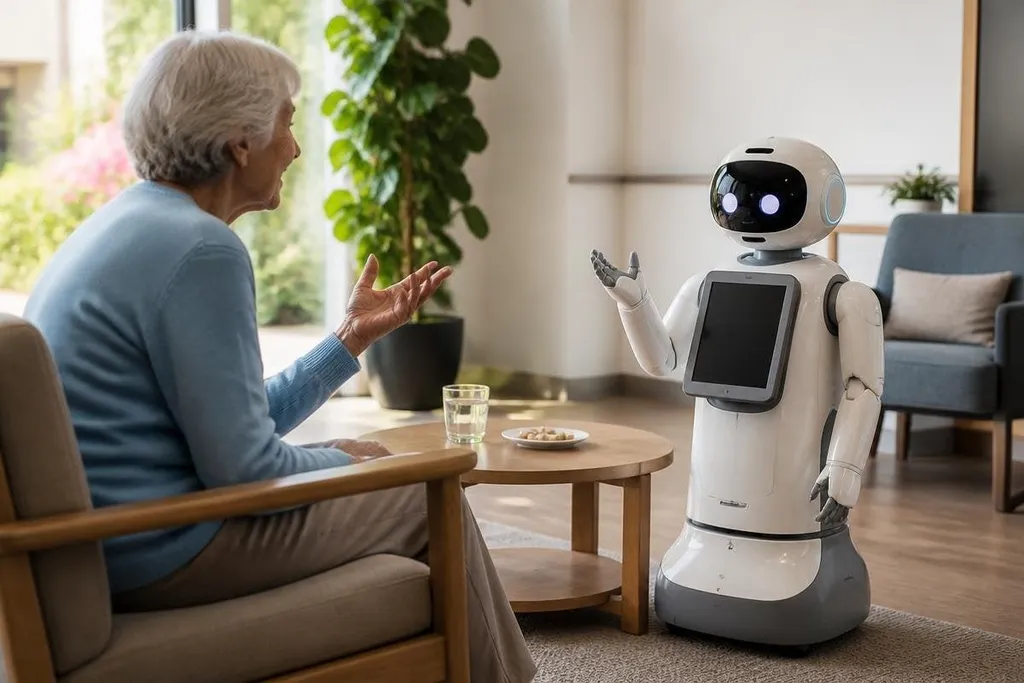
A social robot can greet a person, read a response, and change its next action. That makes it different from a machine that only repeats a fixed task. For families, schools, care teams, and service staff, the main question is where that response adds real help.
Quick read
- Social robots use speech, gaze, movement, and touch to guide a conversation.
- They can make repeated support tasks easier to start and follow.
- Their limits show up when people need judgment, trust, privacy, or care from another person.
What makes a robot social
A social robot communicates through more than words. It may turn toward a speaker, pause after a question, raise an arm, or use a screen to show the next step. These signals give a person clues about what the robot heard and what it will do next.
The robot needs sensors and software to connect those signals. Microphones pick up speech. Cameras can track a face or body position. Touch sensors can detect contact. The control system then chooses a response from its available actions.
That process can feel like a conversation, but it does not mean the robot understands a person as another person would. It matches input to programmed rules or learned patterns. A pause may mean confusion, a request for more time, or a network delay.
Where people notice the change
The clearest change comes in repeated situations. A robot can greet visitors, ask the same training questions, remind someone about a task, or guide a person through a set of steps. The person gets a response instead of a silent screen or a printed notice.
That response can affect behavior. A spoken prompt may help a child stay with a lesson. A moving face or hand can draw attention to the next step. A care robot may remind someone to drink water, then alert a staff member when the person does not respond.
The value depends on the task. A robot that repeats a short exercise has a defined job. A robot asked to calm a distressed person has a much harder one, because tone and context can change from one moment to the next.
A social robot can sound warm while storing speech and movement data. Reports at Robot24 can tie those details to a named maker, model, test setting, and date. That gives the next section a clear place to start: what the robot records and who may see it.
The human cost of a smooth conversation
People may find a social robot easier to approach, but that does not remove the need for people. Someone still has to check the robot's responses, fix faults, protect personal data, and decide when a human should take over.
Privacy needs a clear answer before deployment. A robot with microphones or cameras may collect voices, images, movement data, or records of a person's requests. You need to know what it stores, where the data goes, and who can review it.
Trust creates another limit. People may speak to a robot as if it has feelings because its voice, face, and timing suggest a social presence. That reaction can help a person take part in a task, but it can also hide the robot's limits.
I'd keep the robot's role narrow until a team has evidence that people understand those limits.
Check the fit before you buy
Use this checklist before placing a social robot in a school, clinic, home, or public space:
- Name the task: Write the exact action the robot must support, such as reminders or guided practice.
- Set the handoff: Decide which signs require a person to take over and how that handoff works.
- Check the data: List every sensor, stored record, access point, and deletion process.
- Test the setting: Try the robot with the room's noise, lighting, furniture, and normal foot traffic.
- Measure the result: Track task completion, missed prompts, staff time, and complaints.
- Plan for failure: Keep a manual process ready for network loss, sensor faults, or an empty battery.
These checks move the discussion from personality to performance. A friendly voice has little value if the robot misses requests in a noisy room or leaves staff with more work.
Social robots will keep changing how people approach machines, but the useful measure stays plain: did the robot help a person complete a task, understand a choice, or reach human support? If the answer cannot be measured, the robot is still a trial, not a finished service.